
Georgetown County Release Date Types
A projected date is a conditional calculation. The South Carolina Department of Corrections defines its Projected Release Date as the date a current inmate is expected to satisfy all incarcerated terms, based on sentence type and the current rate of applicable work, education, and good-time credits. Continued credit earning is an assumption, not a promise.
An actual release date records that a custodian stopped holding the person. Georgetown County's Sheriff Booking and Release page can show an exact GCDC departure timestamp. The separate SCDC Released Inmate Search addresses completed state-prison releases. Neither should be confused with Projected Parole Eligibility, which marks eligibility or hearing timing and does not prove departure.
A pretrial person at Georgetown County Detention Center has no sentence end to calculate. Bond may be set, but the displayed amount does not prove its conditions were met. Court orders, warrants, detainers, and processing can affect whether and when the person leaves.
Lookup Georgetown County Release Dates
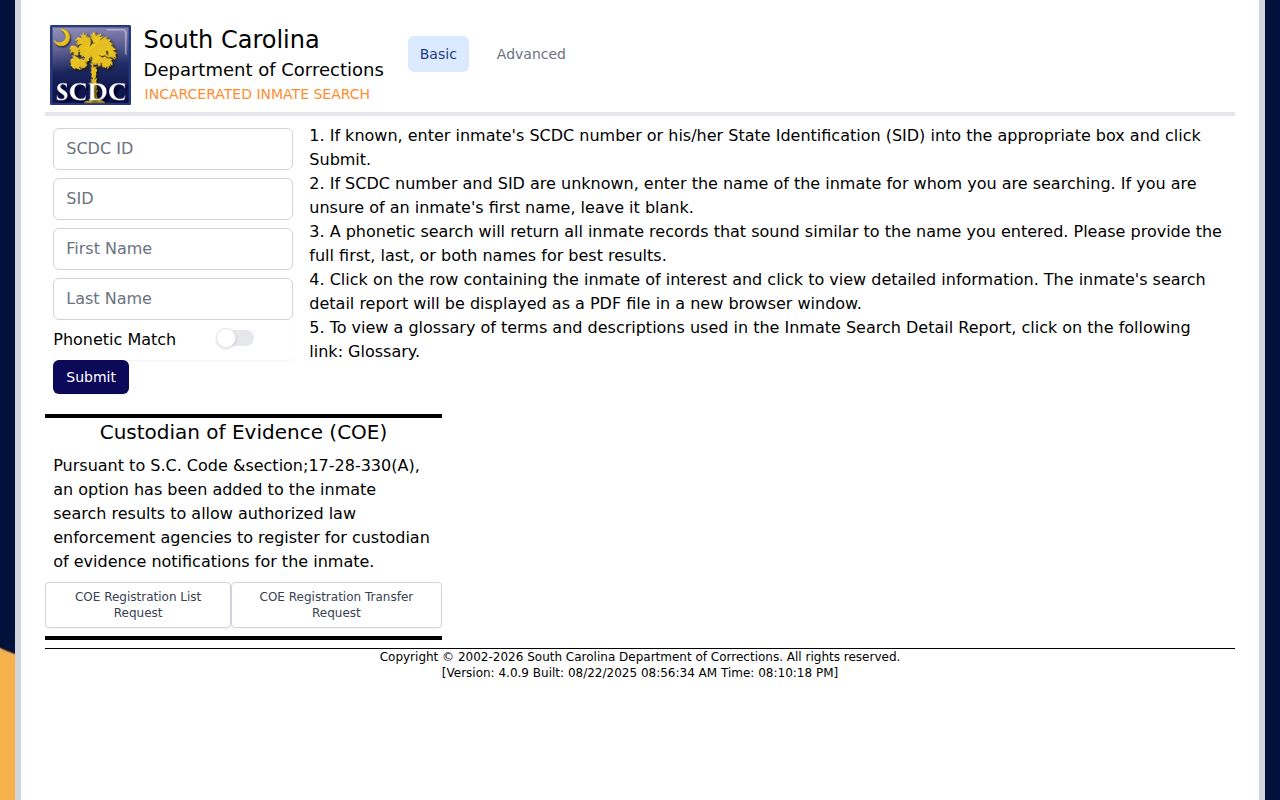
Start with custody class. SCDC operates two public tools with different jobs. Its Incarcerated Inmate Search covers people currently sentenced to and incarcerated in state corrections and can show a projection. Its Released Inmate Search uses a release-date range, county selection, and sex-offender filter for completed state-prison releases.
- Determine whether the person is at GCDC, in SCDC custody, or in another system.
- For current SCDC custody, search by SCDC ID or SID when known, or use name and phonetic options.
- Open the detailed record and read Projected Release Date separately from Projected Parole Eligibility.
- For a GCDC sentence, ask the detention center or court for the sentence, jail credit, and official computation.
- After departure, use the Sheriff timestamp or SCDC released search, then request the underlying record if more detail is needed.
SCDC advanced search also exposes Projected Release Date Start and End. A result in that future range is still a current-prison search result, not a list of people already released. Search results are capped, so an identifier is best when available.
The broader Georgetown County released inmate lookup explains the court, Sheriff, records, and receiving-custody checks if the person has moved between systems.
Georgetown County SCDC Date Fields
The SCDC detailed-information record may show SCDC ID, SID, sentence type, admission date, projected release, projected parole eligibility, offense and sentence details, a photo, and physical descriptors. The descriptors may date from admission and may not be current. The date fields need the same care.
| Date or field | Meaning |
|---|---|
| Admission Date | Entry into the reported state-corrections episode. |
| Projected Release Date | Conditional date for satisfying incarcerated terms under the current credit rate. |
| Projected Parole Eligibility | Eligibility or hearing timing, not physical release. |
| Actual SCDC release | Completed departure found through the separate released search or official record. |
| GCDC release timestamp | Minute-level departure from the county facility, without public reason or destination. |
The official SCDC offender search is the source for a current state prisoner's projection.
The displayed date should be transcribed with its field label. It should not be restated as a guaranteed discharge day.
Note: An SCDC projection and parole eligibility date describe different paths, and neither is proof of completed release.
Georgetown County Sentence Credits
South Carolina Code Title 24, Chapter 13 sets several credit rules. Section 24-13-210 provides a 20-day-per-month good-conduct deduction for eligible SCDC prisoners who are not no-parole offenders. A no-parole offender receives three days per month, subject to statutory limits and the 85 percent floor. Credits can be forfeited for violations.
Section 24-13-230 allows eligible prisoners who are not no-parole offenders from zero to one day of credit for each two days of productive duty or qualifying education. Combined work and education credits are capped at 180 days per year. The no-parole framework uses six days per month and a combined 72-day annual cap, but those credits cannot defeat the statutory 85 percent floor and exclusions still apply.
Section 24-13-100 defines a no-parole offense for this framework as a class A, B, or C felony or an unclassified offense under Section 16-1-10(D) with a maximum term of 20 years or more. Under Section 24-13-150(A), a person convicted of such an offense and sentenced to SCDC, including a qualifying designated local-facility arrangement, cannot receive early release, discharge, or specified community supervision before serving at least 85 percent of actual imprisonment imposed. The unsuspended term controls. Work, education, and good-conduct credits cannot lower time below that floor.
The rule is not universal. Applying 85 percent to every Georgetown County sentence would be wrong. Offense class, sentence type, exclusions, and the agency's official calculation must be checked first.
Georgetown County Jail Good Time
Section 24-13-210 also states that a person sentenced to a local detention facility or county public works receives one day of good-conduct credit for each two days served. This is a statutory baseline for a local sentence. It does not create a safe do-it-yourself release forecast.
No published Georgetown County Detention Center computation procedure was found. Ask GCDC or the sentencing court for the official calculation, including the sentence start, jail credit, and any forfeiture or controlling order. A county booking may also be pretrial rather than a local sentence, in which case this calculation does not apply at all.
Section 24-13-125 has an 80 percent threshold concerning work-release eligibility for no-parole offenders. It must not be confused with the 85 percent release or discharge floor. Work-release eligibility, parole eligibility, a projected date, and actual release are four different events.
Note: Georgetown County publishes no local calculation method, so the jail or court must confirm how the statute applies to one sentence.
Why Georgetown County Dates Change
A projected date is recalculated as its inputs change. SCDC's field assumes the present credit rate continues. Conduct, a corrected sentence, or a new legal hold can alter that assumption. Simple arithmetic cannot account for all terms.
| Factor | Possible effect |
|---|---|
| Credit earning | Qualifying good, work, or education credit can move the projection under the applicable statute. |
| Forfeiture or restoration | Discipline can remove credit; authorized restoration can revise the total again. |
| Concurrent or consecutive terms | The way multiple sentences run changes the controlling end date. |
| Jail credit or correction | Credited prior custody or a corrected order can alter the computation. |
| Detainer or hold | Another authority may take custody even when the first term ends. |
| Parole action | Eligibility and Board decisions affect a separate release route. |
| New court order | Later judicial action may change the lawful basis or timing. |
A detainer is a request from another authority to hold the person or give notice before release. It can turn departure from one facility into transfer to another. That is why “released from GCDC” should not be shortened to “free” when destination is unknown.
Georgetown County Parole Timing
South Carolina parole eligibility is offense- and date-sensitive. Section 24-21-610 contains formulas that can involve one-third of a sentence, ten years for some long or life terms, mandatory minimums, one-quarter rules, and separate ineligibility provisions. Earned credits and offense-specific laws add more variables. Generic arithmetic is not reliable.
The SCDPPPS hearing search says schedules are generally finalized and searchable about 30 days before a hearing. A scheduled hearing is not release. Even a favorable decision is an authorization-stage event. Section 24-21-650 links release to a parole order and acceptance, while administrative steps or other holds can remain.
Use the exact official result vocabulary and then check SCDC custody, the actual release record, and DPPPS supervision. A transition from SCDC custody to DPPPS supervision paired with a recorded release is stronger than the hearing result alone.
Confirm Georgetown County Release
For GCDC, search the Sheriff's Booking and Release page by name or release date. A matching exact timestamp proves the county facility recorded departure, but the public entry does not show reason, authority, or destination. Contact GCDC at 843-545-3400 or request the release record when transfer versus community return matters.
For SCDC, use the separate Released Inmate Search after the event. If the former prisoner remains under supervision, the DPPPS search may show that status on the next day's public data. For an official computation or discharge record, email FOIA@doc.sc.gov or write the SCDC FOIA Coordinator, Office of General Counsel, PO Box 21787, Columbia, SC 29221-1787.
SC VINE can send a custody-change alert, but it is a prompt rather than the final record. The Georgetown County VINE Inmate Check explains registration, the telephone PIN, re-registration after transfer, and the local victim-notification layer.
Keep the conclusion narrow. A projected date predicts a possible endpoint. An agency's completed record confirms that agency's release. Another custodian or post-release supervision may still follow.