
Understanding Georgetown County Releases
A Georgetown County release is the end of one custodian's control, not always the end of all custody. The Sheriff's public Booking and Release page can show the minute when Georgetown County Detention Center recorded a departure. It does not identify the release reason or the next destination. A person may return to the community, move to a South Carolina Department of Corrections institution, enter federal custody, or, when the facts support it, transfer to immigration custody. The wording of any conclusion should name the system that released the person.
Bond, recognizance, time served, sentence completion, parole, probation, dismissal, and transfer have distinct meanings. Parole is Board-authorized release with supervision. Probation is a court-ordered community sentence. Time served means custody may satisfy the term imposed, while a transfer simply ends one facility's custody. A court dismissal can explain legal authority, but another hold may still delay departure. The public timestamp is strong proof of a GCDC departure, yet the underlying release record is needed when reason or destination matters.
Georgetown County Release Routes
The next record source depends on how the person left. Georgetown's public page gives a release time and booking context, but it does not label any of these routes. Treat the table as a guide to the record that can confirm the event, not as a way to infer an outcome from a missing name.
| Route | Meaning and next check |
|---|---|
| Bond or recognizance | Pre-disposition release after conditions are met; compare the jail timestamp with the correct bond-court docket. |
| Time served or sentence completion | A court or corrections record should confirm the completed term and any supervision that follows. |
| Parole or probation | Check SCDPPPS because the person may be outside a jail but still under state supervision. |
| SCDC transfer | Search the current SCDC incarcerated tool; leaving GCDC is not release from incarceration. |
| Federal or ICE transfer | Use the federal docket, BOP, USMS, or ICE only when the case facts identify that custody route. |
Georgetown County Release Record Fields
The Sheriff's online entry ties a person to one booking through a photo, displayed name, sex, age, date of birth, booking time, arresting agency, charges, bonds when present, and an exact release timestamp. It omits the release type, authority, destination, booking number, disposition, and a clear current-custody label. Ask for the underlying record when the public entry does not answer the question.
| Field | What it shows |
|---|---|
| Name, DOB, booking number | Separates similar names and identifies the correct booking episode. |
| Booking and release times | Marks the period GCDC recorded custody. |
| Release type and authority | Distinguishes bond, court order, time served, parole, dismissal, or transfer. |
| Destination or receiving agency | Separates community return from SCDC, another jail, USMS, BOP, or ICE. |
| Case and disposition | Links the jail event to the lasting court record. |
| Supervision referral | Identifies parole, probation, or other community supervision after release. |
| Booking photo and date | Connects an image to this specific intake rather than another arrest. |
No official archive-retention promise was found. Research on August 1, 2026 observed thousands of entries and release data extending back at least to February 2024, but that observation is not a guarantee. Save the exact source details or seek the official record when a durable confirmation is required.
Bonding Out in Georgetown County
Three court schedules can affect a Georgetown booking. County Bond Court meets daily at 9 a.m. and 3 p.m. Georgetown Municipal Bond Court meets at 11 a.m., while Andrews Municipal Bond Court meets at 10:30 a.m. and 2 p.m. The arresting agency shown on the booking entry helps identify which court trail to inspect. Sheriff's Office and state-agency charges ordinarily use County Bond Court; Georgetown Police and Andrews Police matters use their municipal courts.
GCDC states that it does not start proceedings, accept bond money, decide dispositions, or set release dates. A displayed bond amount therefore proves only that the amount or condition reached the booking record. It does not prove payment, satisfaction of conditions, or physical release. Read the official GCDC Bond Court guidance before using the screenshot below.
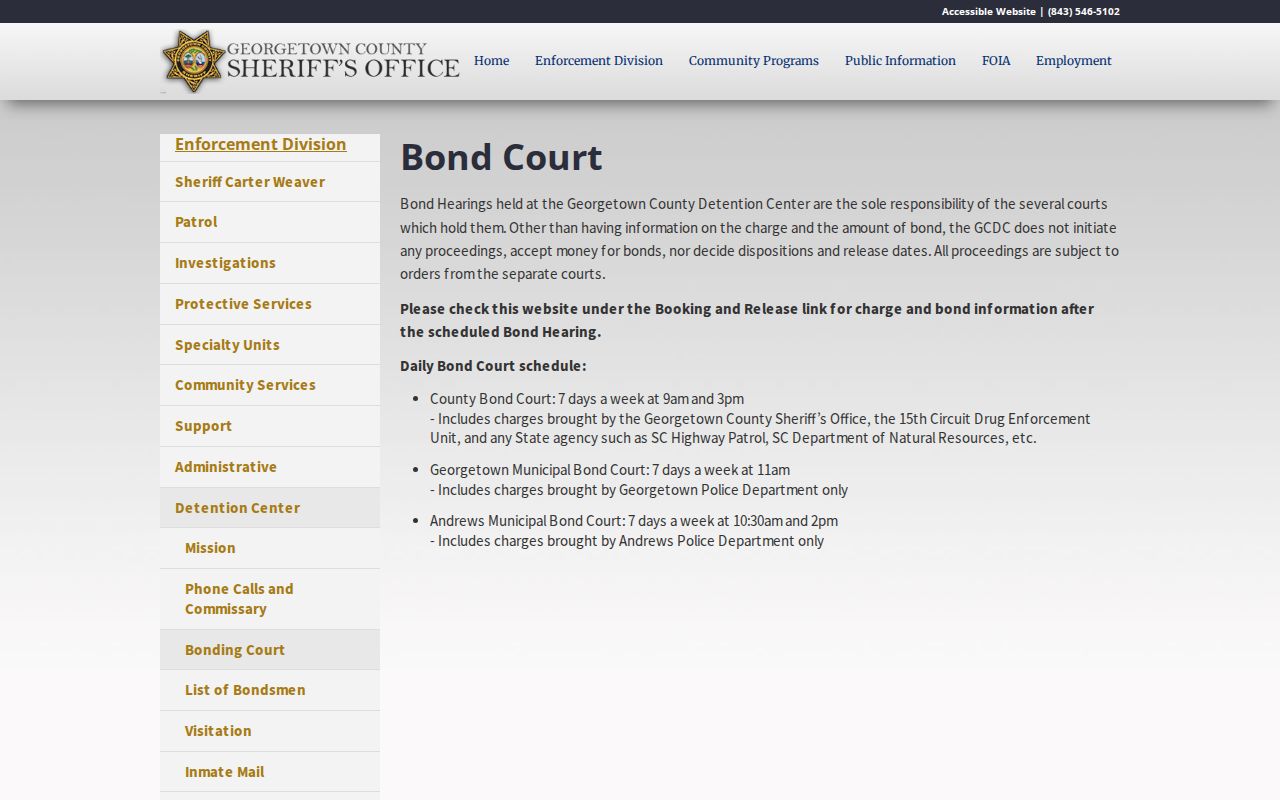
The court schedule explains the decision path, while the separate Booking and Release timestamp is the better public proof that jail processing ended.
Request Georgetown County Release Records
A focused South Carolina Freedom of Information Act request can fill the gaps in the public entry. Ask for an existing booking sheet and release or disposition record. Include the person's name, date of birth, approximate booking and release dates, and case or incident number if known. Request the exact release time, type, authorizing order, destination, booking number, and public intake photo. Agencies need not create a new explanation, so precise record terms matter.
- Check the official Booking and Release page and note the matching booking details.
- Use the Sheriff's FOIA page or printable request form.
- Send it to FOIA Request, Georgetown County Sheriff's Office, PO Box 1292, Georgetown, SC 29442.
- Ask for electronic delivery and a cost estimate before fees exceed the limit you set.
- If a field is withheld, request the statute supporting that redaction or denial.
The Sheriff's posted schedule lists $0.35 per page, staff time at $20 per hour with some specialized work potentially higher, and $5 for a CD or DVD. A deposit of up to 25 percent may be required. For recent records, Section 30-4-30 generally allows 10 business days for an availability decision; records older than 24 months generally allow 20 business days. Production periods are separate and can run 30 or 35 calendar days under the statute. The FOIA administration number is 843-546-5102.
Georgetown Release Records and FOIA
South Carolina Code Title 30, Chapter 4 covers documentary material held by public bodies, including papers, photographs, cards, and recordings, unless an exemption or another law closes it. Fees must track actual search, retrieval, and redaction costs. An agency does not have to create an electronic record that does not exist. Juvenile, sealed, expunged, medical, victim, security, privacy, or sensitive law-enforcement material may be withheld or redacted.
Property After Georgetown County Release
Release and property pickup can occur on different tracks. The GCDC FAQ says an authorized person may collect property Monday through Friday from 8:30 a.m. to 5 p.m. The visitor must show photo identification matching the name placed on the inmate's Property Release Form. That requirement makes the form, not an informal family arrangement, the key authorization.
Transfer creates a short deadline. Property belonging to a person transferred to SCDC or another facility is held for 30 days and then destroyed if it is not collected. Confirm the receiving custodian first, then follow GCDC's pickup instructions. The detention center FAQ is the source for both the identification rule and the retention period.
Georgetown Release Data Can Lag
A sparse new booking entry does not prove that no charge or bond exists. GCDC explains that charges are posted after warrants are served by the arresting agency. Bond information follows after Bond Court sends paperwork to the booking officer. Those two local steps can make a recent record look incomplete even while the legal process is moving.
Use the arresting agency to choose the court, then read the Georgetown Public Index docket in date order. Look for bond changes, release orders, pleas, sentences, time-served credit, probation, dismissal, remand, or later expungement-related changes. A court order explains legal authority, but it may not show the exact minute that GCDC completed the release. Pair it with the jail timestamp.
The Georgetown Public Index provides the official court search illustrated below.
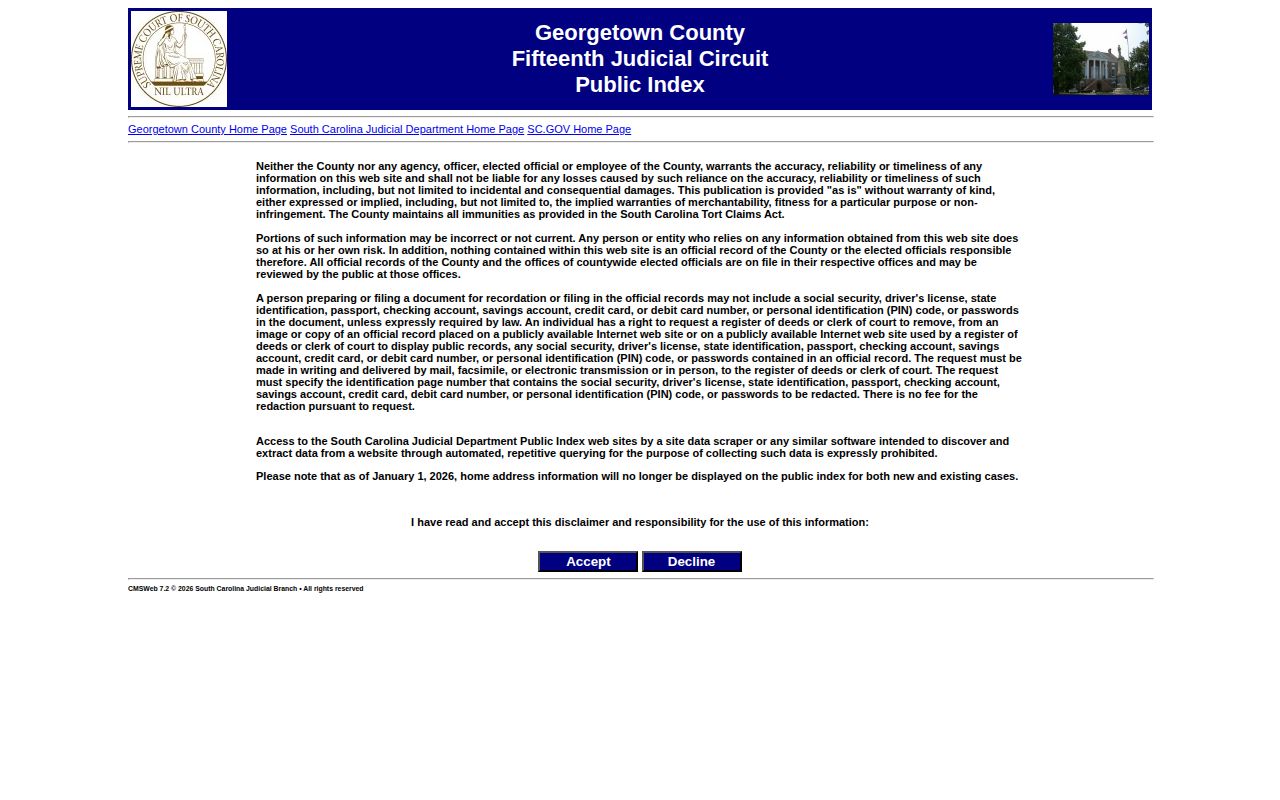
This court view can preserve the case history after a short jail display changes, though sealed or expunged matters may no longer be public.
Find Georgetown County Released Inmates
Start with custody class. A broad name search can mix a county booking, state sentence, federal case, and supervision record. The following order tests the most likely Georgetown source first, then follows evidence of transfer or a different authority.
- Search GCSO by name or Release date and match DOB, booking time, arresting agency, and charges.
- Read the exact release timestamp, but do not infer its reason or destination.
- Search the Georgetown court docket for the order or disposition that explains the departure.
- Check current SCDC custody, then the separate SCDC released list for a completed prison release.
- Use SCDPPPS for parole or probation and SC VINE for a known person's custody-change notice.
- Use BOP, USMS, or ICE only when the booking, docket, detainer, or other record points there.
- Request the sheriff or SCDC release record when the online trail remains unclear.
The official Georgetown Booking and Release search shows both search choices and released entries.

Its minute-level timestamp is useful, but the missing release reason and destination explain why the search must continue when the next custody status matters.
Georgetown SCDC Release Search
South Carolina provides two different SCDC tools. The SCDC Released Inmate Search requires a release-date range and county selection and includes a sex-offender filter. It covers release from state corrections, not every bond or time-served departure from GCDC. Do not assume the county selector means county of conviction, residence, or destination unless the returned system defines it.
| Tool or field | Correct use |
|---|---|
| Released list: date range | Builds a bounded state-prison release search. |
| Released list: county | Narrows results, but its meaning should be checked in the result. |
| Current search: SCDC ID or SID | Best identifiers for someone still in state prison. |
| Current search: name or phonetic match | Finds a current prisoner when an ID is unknown. |
| Projected release range | Filters current records by a conditional future date, not completed releases. |
The Incarcerated Inmate Search is for people currently sentenced to and held by SCDC. Its detail can show a photo, admission data, sentence information, Projected Release Date, and Projected Parole Eligibility. Those projected fields can change. A fully discharged person may disappear from that current tool, so move to the released list, DPPPS, court record, or SCDC FOIA.
Georgetown Release Supervision and Reentry
SCDPPPS, not GCDC or SCDC, runs the state supervision lookup. It accepts several name, SID, year-of-birth, and county combinations. Georgetown is available in the county field. A match supports current inclusion in supervision data, not incarceration. Results represent the prior day, and a person whose supervision ended may no longer appear. Contact the county office for a same-day answer.
Local reentry work is distinct from legal supervision. The Sheriff's Reentry Program has documented education and personal-development work. One participant learned that release would occur before his final GED test, then completed the test virtually after leaving custody. Official plans for the replacement detention campus also include a separate reentry building. These facts show a local bridge across release, but neither participation nor a certificate proves parole or probation status.
Georgetown Expungement and Release Records
Expungement can explain why a historical booking, release entry, or photograph is no longer public. Under Section 17-1-40, qualifying dismissed, discharged, or not-guilty matters can lead to removal of public-facing arrest records, warrants, mugshots, and fingerprints. Limited agency material may remain sealed for defined purposes and periods. A missing public record therefore does not prove the event never occurred.
Georgetown has a local application and payment route through the Fifteenth Circuit Solicitor. Section 22-5-910 also supplies paths for some qualifying convictions after the required waiting period and conditions. Eligibility is not inferred from release alone. Use the Georgetown County Solicitor information and the circuit process for the current procedure.
Georgetown Release Alerts and Transfers
SC VINE covers participating sources including GCDC, SCDC, and SCDPPPS. Search by name or offender number, inspect the reporting agency and location, and register for a custody-status notice. Phone registration uses a four-digit PIN; email and text do not. VINE says source systems send data to its central database every 15 minutes, but that interval is not a promise that GCSO entered an event at once. Re-register after an interagency transfer and verify each alert with the agency.
Federal routes require separate checks. A BOP result with a past date and location “RELEASED” means no longer in BOP custody, not necessarily free of supervision or another custodian. USMS has no public former-detainee locator, so use the federal docket, housing jail, district office, or FOIA. ICE ODLS is appropriate only with a documented immigration link. No current ICE contract site at GCDC was verified, and an ICE no-result cannot establish community release.
Compare Georgetown Release Search Sources
Each search proves only what its agency records. Use a current-custody product to test a transfer, a release product to prove that custodian's departure, and the court or underlying record to explain authority.
| Situation | Best source | Limit |
|---|---|---|
| Current or released GCDC booking | GCSO Booking and Release | No public reason or destination field. |
| Current state prisoner | SCDC Incarcerated Search | Not a former-prisoner archive. |
| Completed state-prison release | SCDC Released Inmate Search | Not a Georgetown jail feed. |
| Parole or probation | SCDPPPS | Prior-day data; ended supervision may vanish. |
| Federal prison release | BOP Inmate Locator | Does not resolve other custody or supervision. |
| Release authority | Georgetown Public Index or agency record | Court time may differ from physical exit time. |
Georgetown Release Facilities Are Changing
The operating Georgetown County Detention Center opened in March 1996 and has a published capacity of 212. The Sheriff's history calls it the county's sixth jail since 1769. A replacement on Browns Ferry Road is expected in early 2027. Official project accounts describe roughly 250 to 256 beds and a separate reentry building. Those plans do not change the present release source: use the operating jail's Booking and Release page until the agencies publish a new process.
The wider custody map also includes SCDC institutions elsewhere in South Carolina, federal custody through USMS housing or BOP institutions, and ICE custody only when individually documented. No SCDC prison was identified inside Georgetown County. A Georgetown case can still move into any of those systems, so the facility name on the verified record controls the next search.
Georgetown County Release Facilities
These pages follow the correct record route for each custodian. GCDC uses the county booking and release record. SCDC uses separate current and released searches. Federal custody separates USMS housing from BOP sentencing, while ICE requires its own locator and supporting facts.
- Georgetown County Detention Center: county departure timestamp, court check, and Sheriff record request.
- South Carolina Department of Corrections statewide institutions: SCDC released list, DPPPS, and SCDC FOIA.
- Federal custody (USMS housing and BOP institutions): federal docket, housing agency, BOP locator, or USMS FOIA.
- ICE custody: ICE locator and ERO confirmation when an immigration connection is documented.