
Georgetown Federal Custody Routes
Federal custody is a chain, not one Georgetown facility. The U.S. Marshals Service takes custody of federal defendants ordered detained before trial, through proceedings, and until delivery to BOP after sentencing. USMS reports that about three quarters of its prisoners are housed in state, local, and private facilities. A person physically held at Georgetown County Detention Center can therefore remain a federal prisoner. The jail address does not identify the legal custodian.
Once a federal sentence places someone in BOP custody, the person may serve it at an institution outside South Carolina. Release from that institution may lead to the community under federal supervision, another custodian, or immigration proceedings. Each statement must name the system. “GCDC recorded departure” is not the same as “USMS released the defendant,” and “no longer in BOP custody” does not resolve every other legal status.
Confirm a Georgetown Federal Release
Establish the federal connection before opening a federal locator. A federal docket, detainer, arresting agency, court order, or custody record can supply that link. A missing county name alone is not evidence of federal movement. When a Georgetown booking has an exact release timestamp, that timestamp proves departure from GCDC but not the reason or destination.
- Match the Georgetown booking by name, date of birth, booking time, and arresting agency.
- Read the federal docket for detention, release, commitment, or sentencing orders.
- For a sentenced federal prisoner, search BOP by register number when possible.
- For a USMS detainee, contact the physical facility or district office because no public former-detainee locator exists.
- Compare the order date, GCDC departure time, and agency status without assuming they occurred together.
- Use FOIA for an existing custody or disposition record when the public trail leaves a gap.
The broader Georgetown County released-inmate search explains the county timestamp, court route, and transfer checks. Federal confirmation should begin only after those records point to USMS or BOP.
BOP Release Search for Georgetown
The Federal Bureau of Prisons Inmate Locator covers federal inmates released after 1982. Many older federal records are held by the National Archives instead. Search with a BOP register number or another supported federal identifier whenever one is known. A name search permits exact name details with optional middle initial, race, sex, and age. Returned information can include name, register number, age, race, sex, release date, and location or status.
| BOP display | Careful meaning |
|---|---|
| Past date and RELEASED | The person is no longer in BOP custody as reflected by BOP. |
| Past date with no facility | BOP explains that release occurred, subject to other custody or supervision. |
| Future release date | A projected date, not proof that physical release has occurred. |
| IN TRANSIT | Movement within federal custody, potentially involving USMS, not release. |
| UNKNOWN | The confinement term is undetermined, not a confirmed departure. |
BOP says locator data update daily. A result may also cover a person who never served a federal prison sentence, including some dismissed pretrial cases, material witnesses, or civil-contempt detainees. No result can reflect a name mismatch, nonfederal custody, or a pre-1982 record. It cannot, by itself, prove that no federal case existed.
The official BOP locator is shown below.
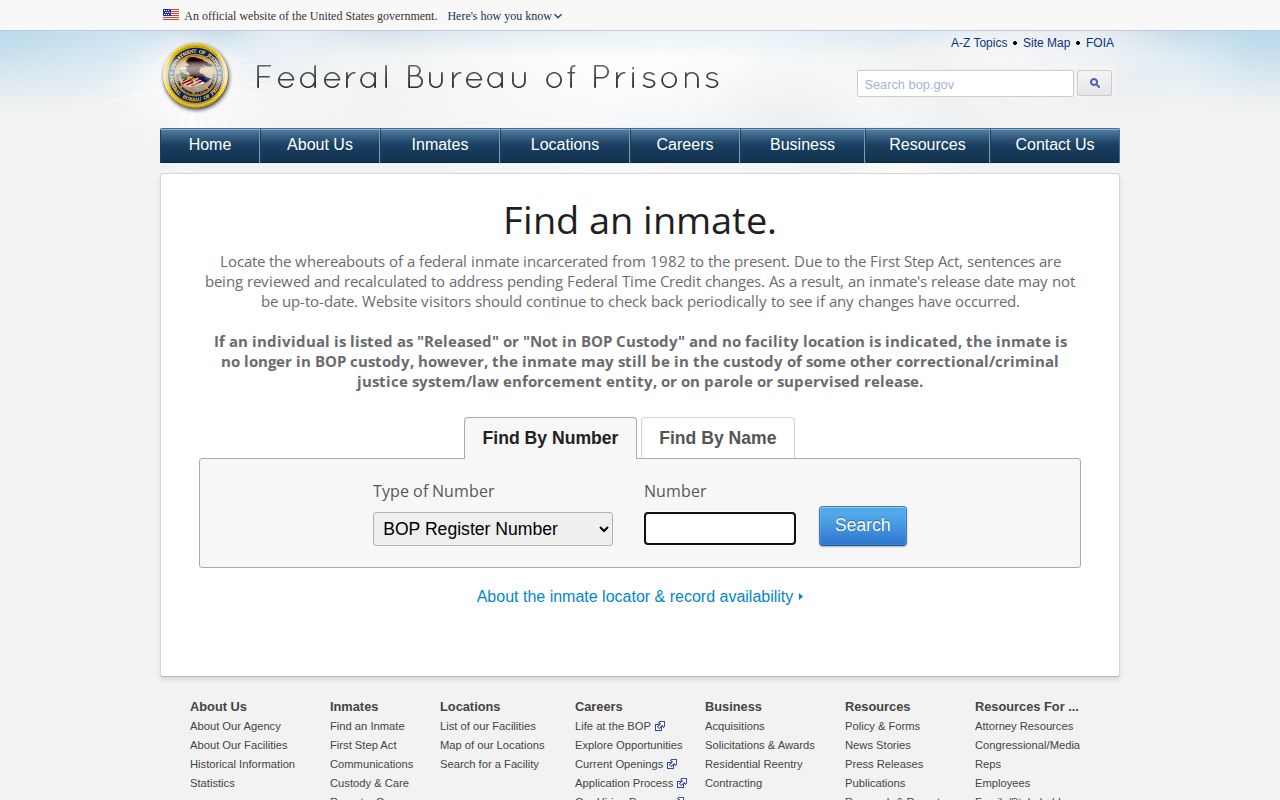
The interface is the best public starting point for a sentenced federal person, but a result must be read with BOP's definition of each status.
What BOP Released Proves
BOP's official locator-record explanation gives “RELEASED” a narrow meaning: the person is no longer in BOP custody. That is useful and precise. It does not establish freedom from federal supervised release, state or local custody, immigration custody, or another legal restraint. A Georgetown County connection may also relate to the original case rather than the release destination.
Keep actual and projected dates apart. A date in the future is not a completed release. “IN TRANSIT” describes movement, and “UNKNOWN” says BOP has not determined the confinement term displayed to the public. None should be rewritten as “released.” If a past date is paired with RELEASED, state exactly that BOP recorded the person as no longer in its custody on that date.
BOP's record explanation is captured here for context.
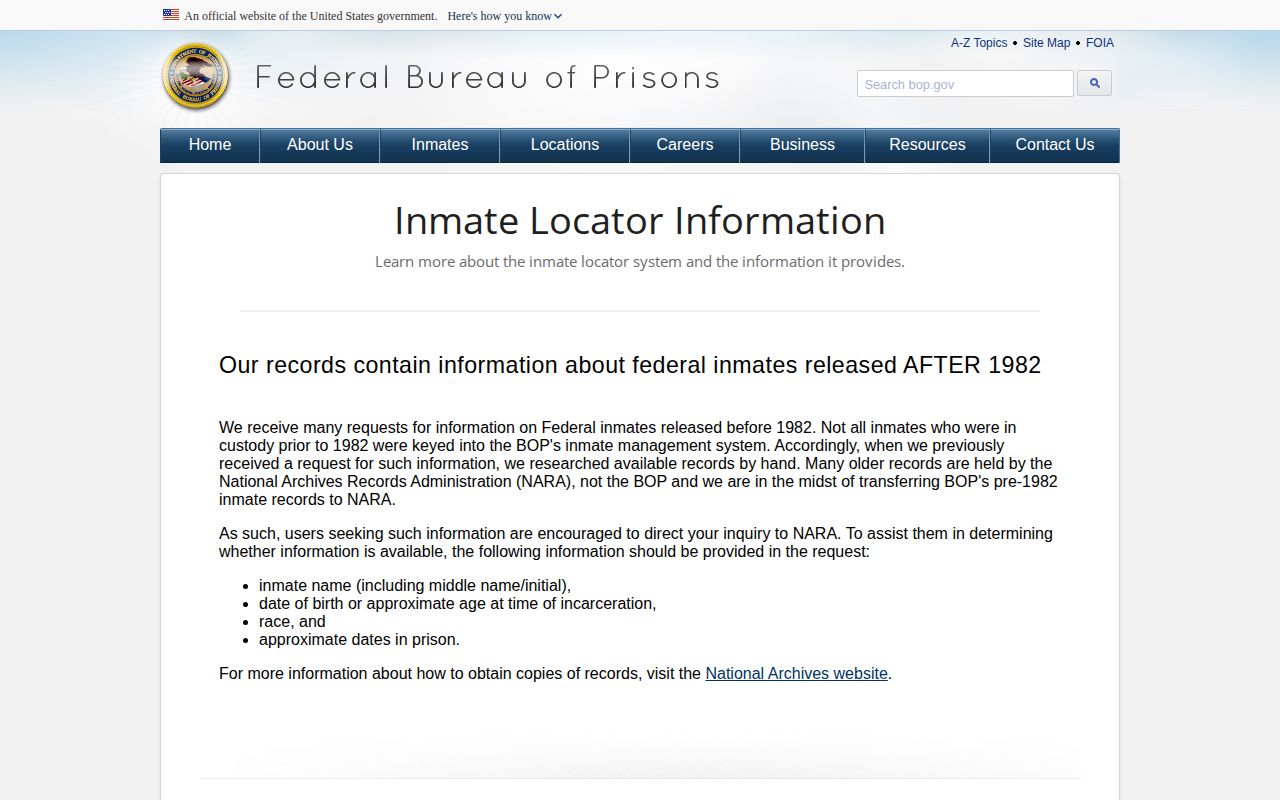
This source supports the status wording and prevents a federal release date from being stretched into a claim about every other agency.
USMS Releases Connected to Georgetown
The U.S. Marshals Service prisoner program covers federal defendants ordered detained until acquittal or conviction and, when sentenced, delivery to BOP. USMS uses outside detention space, including local jails. That makes the GCDC release timestamp relevant to physical departure but incomplete as a federal custody record.
USMS has no public person-by-person locator for former prisoners. Its Prisoner Tracking System contains identity and disposition information, but it is not a public search portal. For a pretrial defendant, use the federal docket to identify a detention or release order, call the physical housing facility for departure timing, and contact the appropriate USMS district office. A court order may authorize release before jail staff finish processing, while a jail departure may instead record transfer to another federal location.
Federal Custody Release Records
When the locator and docket do not resolve the custody path, ask for existing records rather than a new explanation. For BOP material, the BOP FOIA page describes the request process. Include a DOJ-361 identity certification and enough identifying information to locate the correct person. Ask for the admission, designation, transfer, and release or discharge information that can lawfully be released.
USMS requests may be filed through FOIA.gov or sent to the Office of General Counsel, FOIA Unit, CG-3, 15th Floor, Washington, DC 20530-0001. Identify the defendant, federal case or register number if known, approximate dates, the Georgetown housing facility, and the exact existing custody or disposition record requested. Privacy and law-enforcement exemptions can limit disclosure.
USMS FOIA Unit
Office of General Counsel, CG-3, 15th Floor
Washington, DC 20530-0001
Georgetown County Detention Center
2394 Browns Ferry Road
Georgetown, SC 29440
843-545-3400
Federal Release Notices and VNS
The Department of Justice Victim Notification System is separate from the BOP public locator. It serves registered federal crime victims and uses a Victim ID and PIN. It is not a general search for Georgetown County federal defendants. The system can be reached at 1-866-365-4968 or through the official VNS portal.
Preserve the date, agency, and exact wording of any notice, then compare it with the live agency record. A notification can concern movement, a hearing, or a custody change and should not be expanded into a release reason that the message does not give. Public BOP status, USMS custody, and VNS registration answer different questions.
After a Georgetown Federal Release
A completed BOP release can be followed by federal supervised release, which is a court-imposed period monitored in the community. It can also be followed by a state or local hold or, when separately documented, immigration custody. A GCDC departure for a federal defendant may lead to another USMS housing site or to BOP rather than the community.
Use a simple evidence chain. The jail record proves the physical departure it records. The docket explains the court's authority. USMS confirms pretrial federal custody or movement, while BOP supplies sentenced-prison status and a completed release date. ICE must be checked on its own facts. Stop once the available sources support a custodian-specific statement; do not turn one agency's release into a universal conclusion.
Compare Georgetown Federal Release Records
Several dates can appear in one federal case. The court may enter an order on one day, the local jail may process physical departure later, and BOP may display a date tied to its own custody. A notice may arrive on another schedule. Preserve the agency attached to each date. When dates differ, that difference can reflect ordinary processing or transfer rather than an error.
| Source | Best use |
|---|---|
| GCSO Booking and Release | Confirms the time GCDC recorded departure. |
| Federal docket | Shows detention, release, sentencing, and later court orders. |
| BOP locator | Shows BOP status, location, and release date for covered federal records. |
| USMS or BOP FOIA | Requests existing agency custody, movement, or disposition records. |
| DOJ VNS | Provides notices to registered federal crime victims, not public locator results. |
A careful finding cites the agency and record date, then states the narrow fact proved. This format also makes later updates easy to reconcile.